Target application
Peak shaving — to reduce grid peak demand and optimize capacity charges. Self-consumption optimization for solar generation. Backup during grid outages. Supplementing the grid feed for EV charging. One system can serve several functions — the trade-off shows up in sizing.
Power (kW) vs. capacity (kWh) ratio
The kW/kWh ratio (power-based P-rate) ties the two dimensions together: the charge or discharge power divided by the rated energy (for example, 0.5P means half the rated energy per hour). The current-based C-rate is similar but relates current to the rated Ah capacity. Actual backup time must be calculated from usable energy, load and losses. The kW requirement follows from the size of the peak to be shaved; the kWh requirement follows from the duration of the peak and the opportunity to recharge between cycles. Peak shaving may justify a higher kW/kWh ratio; longer backup needs more kWh at the same power. The target application's actual demand drives the ratio — not the other way around.
Cell chemistry and life
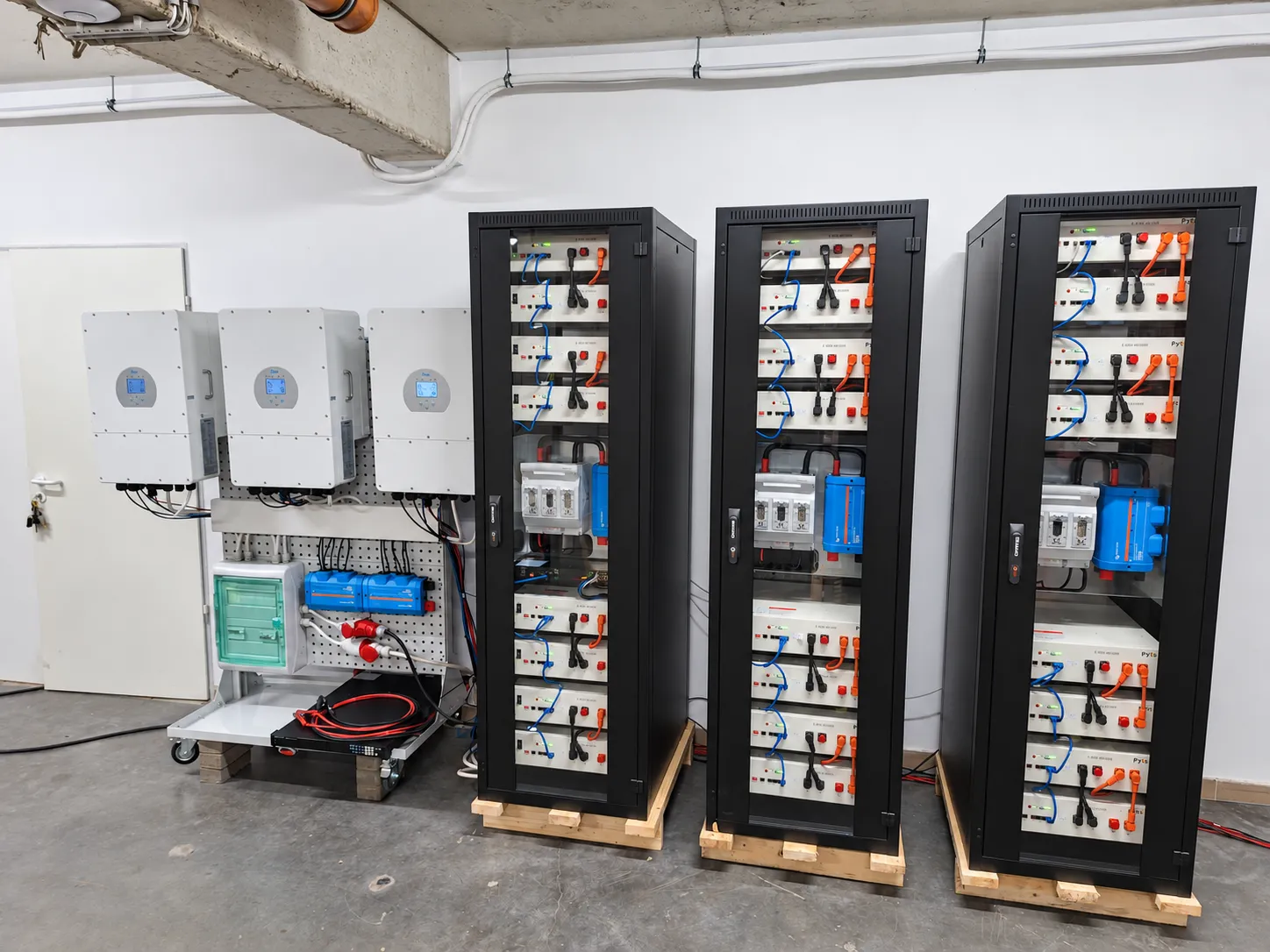
LiFePO4 is the typical choice for the commercial segment — safe, long cycle life, with reasonable footprint. Manufacturer cycle counts come with conditions, and a fair comparison needs DOD, C- or P-rate, temperature and end-of-life capacity; datasheets do not always state all of them. The Pytes Pi Station datasheet, for example, states 6,000 cycles at 90% DOD, 0.5P/0.5P, 20–35 °C and 70% end-of-life capacity, and the cell manufacturer data for the Hoymiles HiOne states 8,000 cycles at 0.5 C, 25 ± 2 °C and 70% SOH. Service life is driven jointly by daily cycle count, DOD and operating temperature.
Hybrid inverter or stand-alone system
If solar generation is also present, a hybrid inverter handles PV, battery and grid connection in one unit. A stand-alone BESS is the right choice when the existing solar inverter is already installed, or when storage is deployed for a different purpose (peak shaving).
Energy management and communication
An EMS (energy management system) controls charge and discharge against the target function. Modbus, SunSpec, OpenADR or a manufacturer-specific protocol with the network operator, the building management system and the solar inverter.
Installation site and scaling
Smaller modular system or outdoor cabinet (small and medium sites), containerized system (large sites). Scalability, fire and electrical safety (EN IEC 62933-5-2, local codes and, where required, VdS / insurer requirements) and site conditions (foundations, cabling, cooling) should be considered at procurement.